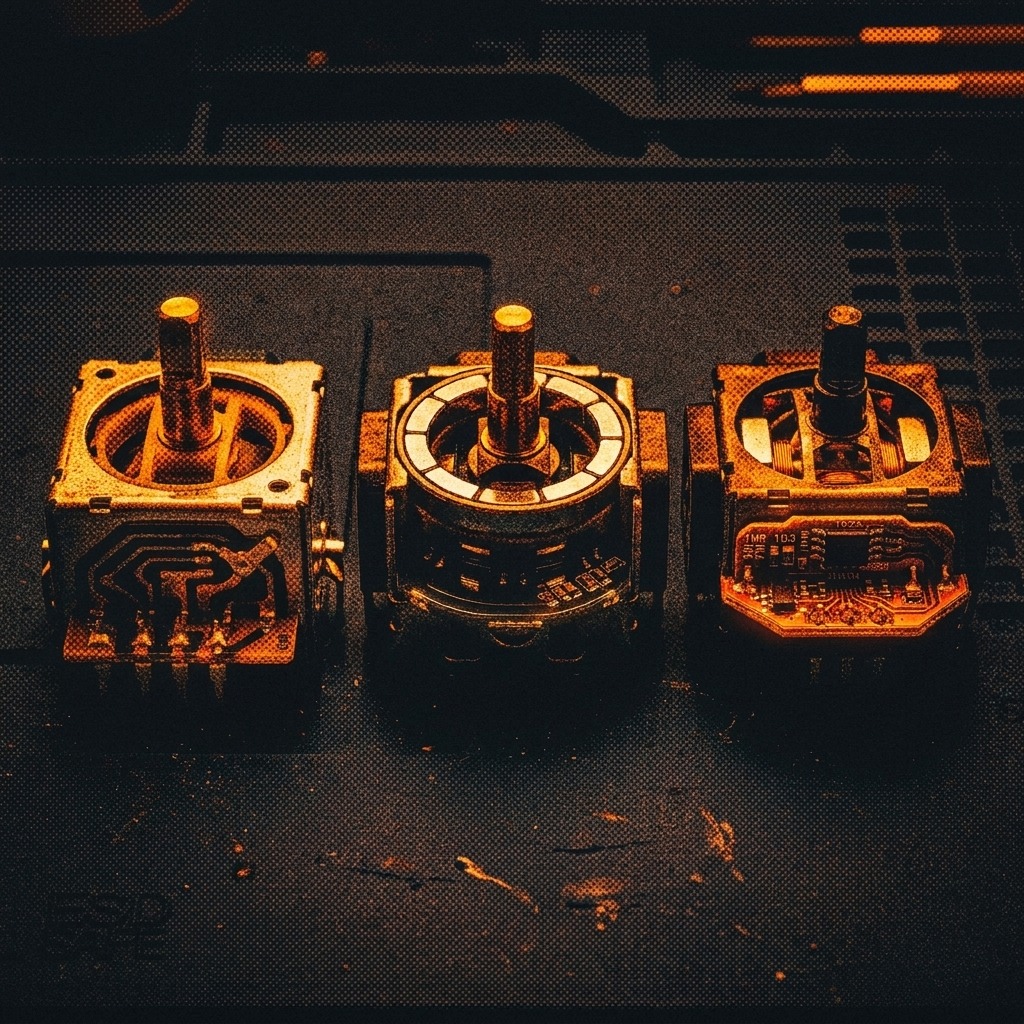
Quick answer: ALPS sticks are traditional potentiometers — a physical wiper drags across a resistive track, which wears out and causes stick drift. Hall Effect sticks replace that contact with a magnet and a stationary sensor that reads the magnetic field, eliminating friction-based wear. TMR sticks use the same contactless idea but a more sensitive quantum sensing method, giving tighter precision and lower power draw than Hall Effect. All three still show up in current controllers — the difference is durability, feel, and price.
The Short Version
| ALPS (Potentiometer) | Hall Effect | TMR | |
|---|---|---|---|
| How it senses position | Physical wiper on a resistive track | Magnet + stationary sensor reading magnetic flux | Magnet + sensor reading quantum tunneling resistance |
| Physical contact | Yes | No | No |
| Drift resistance | Poor — wears with use | Very good | Very good, slightly better center precision |
| Typical rated lifespan | ~1–2 million cycles | ~5–10+ million cycles (varies by manufacturer) | Comparable to Hall Effect, with lower power draw |
| Precision / sensitivity | Adequate for casual play | Good | Highest — detects smaller field changes |
| Cost | Cheapest, industry default | Moderate premium | Highest premium, still niche |
| Common in | Stock Xbox, PlayStation, budget pads | GuliKit modules, Victrix Pro BFG Reloaded, Stealth Ultra, GameSir G7 SE | SCUF Valor Pro, GameSir Tarantula Pro / T4 Cyclone Pro, ROG Ally X |
ALPS Joysticks: The Industry-Standard Potentiometer
“ALPS joystick” has become informal shorthand for the standard potentiometer-based thumbstick found in the vast majority of controllers — Xbox, PlayStation, and most budget third-party pads — because ALPS Alpine is one of the primary manufacturers of these modules.
How It Works
A potentiometer measures position through physical contact. A conductive wiper is mechanically linked to the stick shaft and slides across a curved resistive track as the stick moves. The track’s resistance changes with wiper position, and that changing resistance is converted into the X/Y coordinate your game receives.
Why It’s Still Everywhere
It’s cheap, extremely well understood after decades of production, mechanically simple to integrate, and it outputs a direct analog voltage that’s straightforward for a controller’s circuit board to read.
The Catch
Physical contact means friction, and friction means wear. Independent estimates place typical potentiometer lifespan in the range of roughly 1–2 million actuation cycles before the resistive track degrades enough to cause inaccurate readings — the mechanism behind stick drift. Exact figures vary by manufacturer and build quality, but the wear mechanism itself is universal to the design.
Hall Effect Joysticks: The Contactless Upgrade
Hall Effect sticks solve the wear problem by removing physical contact entirely. The technology is named for the Hall effect, discovered by physicist Edwin Hall in 1879: when a magnetic field is applied perpendicular to a current-carrying conductor, it generates a small voltage proportional to the field’s strength.
How It Works in a Joystick
A small magnet is mounted on the stick’s shaft. A stationary Hall Effect sensor nearby measures the magnetic flux as the magnet moves with the stick. Because the magnet and sensor never touch, there’s no mechanical wear at all.
The Upsides
- Longevity — estimates commonly cited by controller manufacturers and industrial-parts suppliers range from roughly 5 million to over 10 million cycles, a substantial jump over potentiometers (figures vary meaningfully by manufacturer, so treat any single number as approximate)
- Environmental resistance — no exposed contact surface means dust, moisture, and minor debris have far less impact on accuracy
- Proven at scale — Hall Effect sensing has been used in controllers since Sega’s console pads in the 1990s, and the approach has only matured since
The Tradeoffs
- Some implementations feel slightly “looser” around center compared to a fresh potentiometer stick, which competitive players doing fine aim adjustments sometimes notice
- Being magnet-based, they can theoretically pick up interference from strong external magnetic fields, though this is rarely an issue in normal home setups
- Moderate cost premium over stock potentiometer sticks
Hall Effect is now the go-to upgrade path for drift-prone controllers — either through pre-built controllers or drop-in replacement modules from companies like GuliKit.
TMR Joysticks: The Newer, More Sensitive Cousin
TMR — Tunnel Magnetoresistance — is a newer magnetic sensing technology that has started appearing in premium controllers and handhelds. It’s often described as the next step after Hall Effect, and while related, the two are genuinely different sensing mechanisms.
How It Works
A TMR sensor is built from two ferromagnetic layers separated by an extremely thin insulating barrier (commonly magnesium oxide, only a few nanometers thick). Rather than generating a Hall voltage, TMR relies on quantum tunneling — electrons pass through that thin insulating barrier at a rate that depends on the relative magnetic alignment of the two layers. As a magnet on the stick shaft moves and shifts that alignment, the sensor’s electrical resistance changes measurably. This tunneling-based approach is markedly more sensitive to small magnetic field changes than a standard Hall voltage sensor.
Why That Matters for Gaming
- Higher input resolution — TMR can detect smaller, more subtle stick movements, which translates to finer micro-adjustments and more accurate tracking in precision-heavy games
- Tighter center feel — several hands-on comparisons report TMR sticks return to center more crisply than Hall Effect, which matters for the tiny aim corrections common in competitive shooters
- Lower power draw — because TMR sensors are more electrically efficient, at least one independent teardown comparison measured roughly 12 extra minutes of battery life in a DualSense controller running TMR sticks versus Hall Effect (an informal test result, not an official manufacturer spec, but directionally consistent with how the underlying sensor works)
The Tradeoffs
TMR controllers and replacement modules remain a smaller, pricier market segment than Hall Effect, and for casual play the practical difference versus a good Hall Effect stick can be hard to notice. It’s an incremental refinement, not a reinvention.
You’ll find TMR in controllers like the SCUF Valor Pro (marketed as “TMR Endurance Thumbsticks”), the GameSir Tarantula Pro and T4 Cyclone Pro, the BIGBIG WON Blitz 2, and ASUS’s ROG Ally X handheld — notably a step up from the original ROG Ally, which used Hall Effect.
The Labeling Trap
One practical warning: some manufacturers market TMR sticks under the more widely recognized “Hall Effect” label, since consumers are more familiar with the term. If a product listing specifically calls out “TMR,” it’s the newer sensor; if it just says “Hall Effect” or “magnetic,” it’s worth checking the spec sheet or teardown reviews before assuming which technology you’re actually getting.
Which One Should You Actually Buy?
- Casual and story-driven gamers: ALPS/potentiometer sticks are fine and the cheapest option — just expect to eventually deal with stick drift after a year or two of regular use.
- Anyone who’s already dealt with drift once: Hall Effect is the practical sweet spot — a large durability jump at a moderate price increase, with a mature track record.
- Competitive shooter and fighting game players: TMR’s higher sensor resolution and tighter center feel offer a real (if incremental) edge for fine aim corrections, and the lower power draw is a nice bonus for wireless sessions.
- Handheld PC gamers: Battery efficiency matters more here, which is where TMR’s power advantage is most noticeable.
Check What’s Inside Your Controller
Not sure whether your sticks are already drifting, or how they perform in practice? Test live stick response, dead zones, and resting values with our free browser-based controller tester — no download required.
Test Your Controller Now
Check stick drift, circularity error, latency, and dual vibration motors in your browser.
Frequently Asked Questions
Is Hall Effect the same as TMR?
No. Both are contactless and magnet-based, which causes some marketing overlap, but they use different physical principles — Hall Effect measures a voltage generated by a magnetic field, while TMR measures resistance changes from electron tunneling through an insulating barrier. TMR is generally more sensitive.
Do Hall Effect or TMR sticks ever drift?
Rarely, and never for the same reason as ALPS sticks. Because there’s no physical contact, they don’t wear out from friction. Very cheap or poorly manufactured units can still exhibit minor drift from a badly calibrated sensor, but it’s uncommon.
Can I replace my ALPS sticks with Hall Effect or TMR modules?
On many controllers, yes — companies including GuliKit sell drop-in Hall Effect and TMR replacement modules for compatible Xbox, PlayStation, and Switch controllers, which is a popular DIY fix for chronic drift.
Which lasts longer, Hall Effect or TMR?
Their contactless designs put them in a similar durability tier, both far beyond potentiometers. TMR’s main measured advantages are in precision and power efficiency rather than raw lifespan.
Related Guides
- What Is Stick Drift, and How Do You Actually Fix It?
- Understanding Controller Polling Rate and Input Lag: Complete Benchmark Guide
- How to Connect a PS5, PS4, and Xbox Controller to PC
Sources
- The Screen Surgery — Understanding the Difference Between Hall Effect, TMR, and ALPS Joysticks
- GameRant — TMR vs Hall Effect Joysticks Explained
- hlplanet — Hall Effect vs TMR Joysticks: What’s the Real Difference?
- hlplanet — Potentiometer (ALPS) vs Hall Effect Sensor in Joysticks
- EasySMX — Hall Effect vs TMR Joysticks: Which Controller Technology Is Better
- Turtle Beach — Hall-Effect vs. Traditional Joysticks: End Drift Forever
- APEM — Hall-Effect Sensor Joystick: Why Choose This Technology?
- Joltfly — Hall Effect Joystick vs Potentiometer: Stop Stick Drift
- Live Electronics Group — Hall Effect vs Potentiometer Controls
- Allegro MicroSystems — What Is TMR: Tunnel Magnetoresistance
- RF Wireless World — Tunneling Magneto-Resistance (TMR) Sensors: Working, Advantages & Disadvantages
- ScienceDirect Topics — Tunneling Magnetoresistance Overview